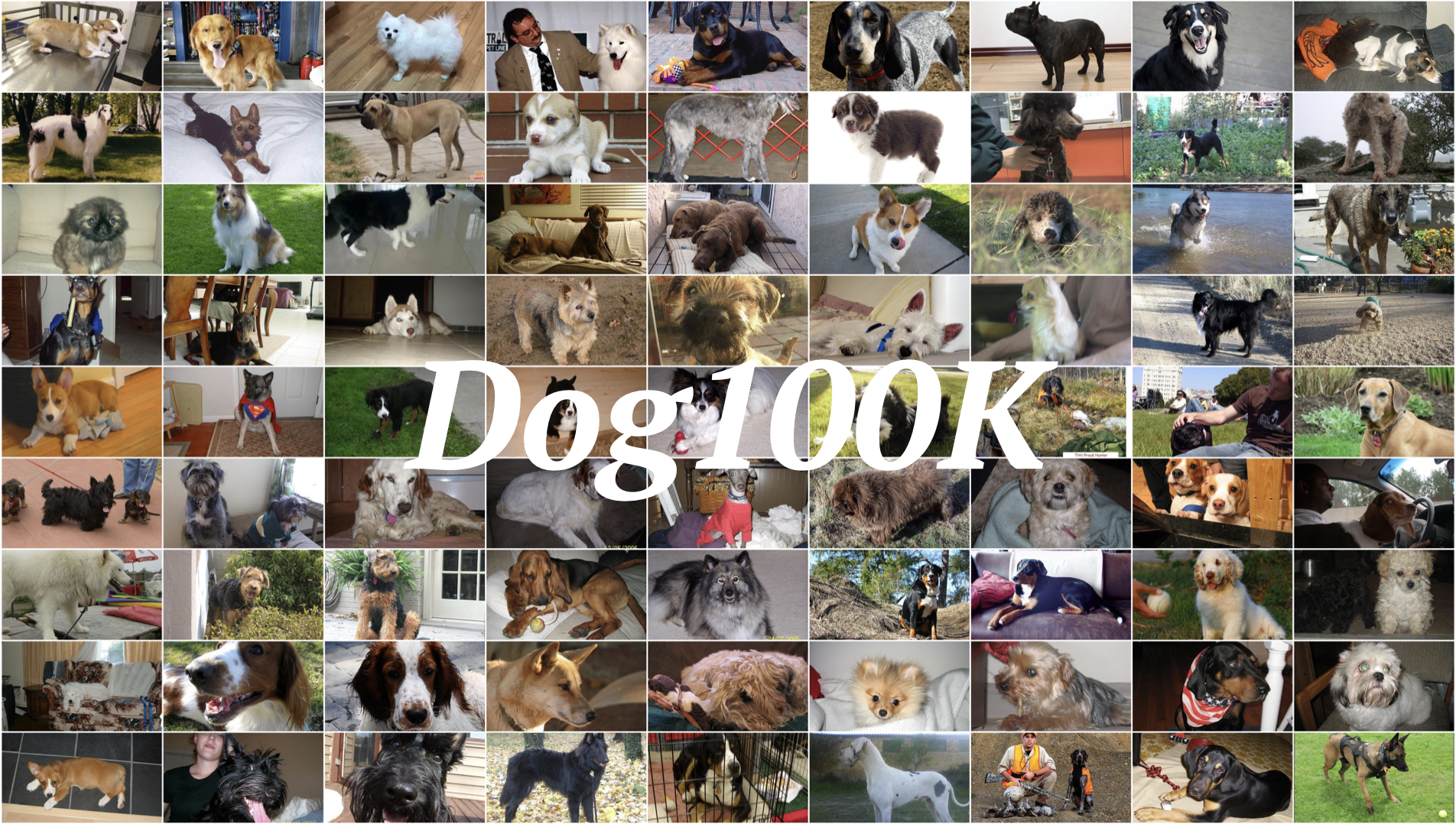
Dog100K: A Large-Scale Dog Image-Text Alignment Dataset
Dog100K is an open-source image-text alignment dataset focused on dogs. It contains 103,508 image-text pairs and is designed for image-text retrieval, multimodal representation learning, image captioning, and conditional image generation.
The dataset was created to provide a focused, high-volume, and semantically rich resource for studying how vision-language models understand dogs across breeds, poses, scenes, lighting conditions, viewpoints, and human interaction contexts.
Why Dog100K Exists
General-purpose image-text datasets are powerful, but they often make it difficult to study a single visual domain in depth. Dog100K narrows the scope to one highly recognizable and visually diverse category: dogs.
This domain-specific setting is useful because dog images naturally contain rich variations:
- different breeds, colors, sizes, and coat textures;
- indoor and outdoor scenes;
- single-dog and multi-dog cases;
- images with or without humans;
- close-up portraits, action shots, and environmental views;
- natural language descriptions with fine-grained semantic details.
By concentrating on one category, Dog100K can support more controlled experiments in multimodal alignment, retrieval, caption quality, and conditional generation.
Dataset Overview
Dog100K includes image files and JSONL annotations. Each line in the annotation file corresponds to one image and its structured metadata.
| Field | Type | Description |
|---|---|---|
filename | string | Image filename, such as 00000001.jpg |
has_human | boolean | Whether a human appears in the image |
multiple_dogs | boolean | Whether multiple dogs appear in the image |
scene | string | A short scene description |
description | string | A detailed natural language description |
A representative annotation looks like this:
{
  "filename": "00000001.jpg",
  "has_human": false,
  "multiple_dogs": false,
  "scene": "bed with colorful blanket",
  "description": "A small dog with light-colored fur is sitting on a colorful blanket, wearing a light blue shirt. The dog has its mouth open and ears perked up, appearing alert and happy."
}
Construction Pipeline
The dataset is constructed through a multi-stage process that emphasizes scale, quality, and semantic consistency.

1. Data Collection
Dog images are gathered from diverse sources to improve coverage across breeds, scenes, poses, image styles, and environmental conditions. The goal is to avoid a narrow visual distribution and make the dataset useful for robust model training and evaluation.
2. Quality Filtering
Images are filtered for relevance, resolution, visual quality, and diversity. Low-quality or irrelevant samples are removed so that the dataset remains suitable for vision-language modeling and generative learning.
3. Fine-Grained Annotation
Each image is paired with natural language information, including breed-related visual cues when available, action, scene, number of dogs, and whether humans are present. This creates a richer supervision signal than a single class label.
4. Validation
Annotations are reviewed and validated for consistency. This step is important because image-text alignment datasets are sensitive to noisy captions and mismatched descriptions.
Highlights
- Large scale: 103,508 image-text pairs.
- Domain focus: A concentrated dataset for dog-centered multimodal research.
- Fine-grained descriptions: Natural language annotations include scene, action, appearance, and contextual information.
- Broad diversity: The dataset covers different lighting, backgrounds, viewpoints, and visual compositions.
- Open access: The dataset is released for research and community use through GitHub and Hugging Face.
Quick Start
Load the dataset directly from Hugging Face:
from huggingface_hub import hf_hub_download
import zipfile

# Download zip file
zip_path = hf_hub_download(
    repo_id="choucsan/Dog100K",
    filename="Dog100K_data.zip",
    repo_type="dataset",
)

# Extract
with zipfile.ZipFile(zip_path, 'r') as z:
    z.extractall("Dog100K")
You can also load the JSONL annotation file:
import json
from PIL import Image

# Load annotations
with open("Dog100K/Dog100K.jsonl", "r") as f:
    samples = [json.loads(line) for line in f]

# Load an image
sample = samples[0]
img = Image.open(f"Dog100K/data/{sample['filename']}")
print(sample["description"])
img.show()
Applications
Dog100K can be used in several research and development settings.
| Application | How Dog100K Helps |
|---|---|
| Image-text retrieval | Supports cross-modal search between dog images and text descriptions |
| Image captioning | Provides fine-grained descriptions for training or evaluating captioning systems |
| Conditional image generation | Supplies paired text prompts and dog images for text-to-image models |
| Multimodal contrastive learning | Enables focused experiments with CLIP-style vision-language alignment |
| Dataset analysis | Makes it possible to study breed, scene, human presence, and multi-dog distributions |
Links
- GitHub: github.com/choucisan/Dog100K
- Hugging Face: huggingface.co/datasets/choucsan/Dog100K
- Quark Netdisk: Download Link
Citation and Contact
If Dog100K helps your work, please consider linking back to the repository or dataset page. For questions, suggestions, or collaboration, contact choucisan@gmail.com.